
Code coverage is an essential ally for improving the quality of your software. In this article, let's explore together what code coverage is exactly, its different forms, its advantages, and also its limitations.
What is Code Coverage?
Code coverage measures the percentage of source code tested by your automated tests. Specifically, it indicates the parts of the code executed during your unit tests or functional tests.
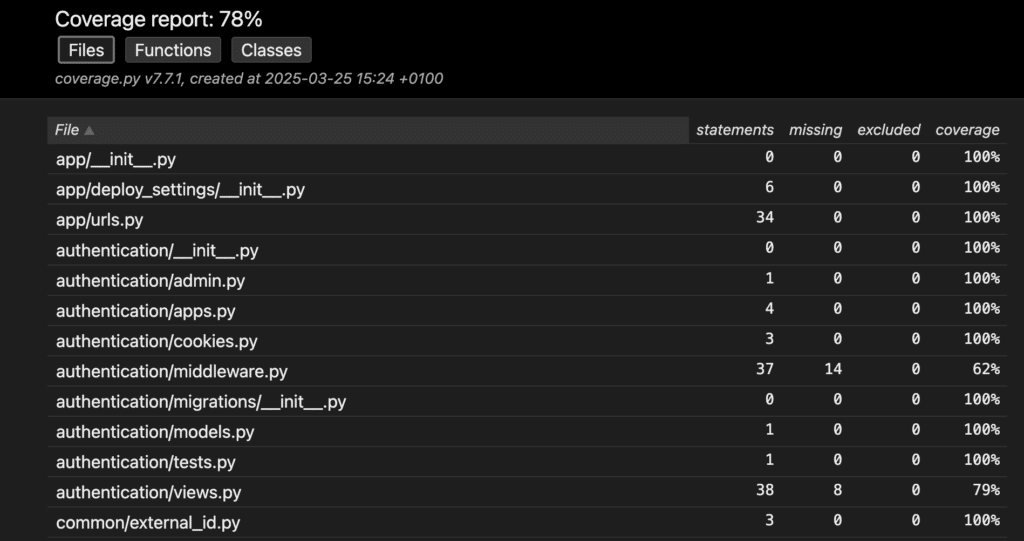
For example, with a Python project, the tool Coverage.py generates a clear report indicating which parts of the code are covered and which require more attention.
However, be cautious:
☝️ A high coverage does not necessarily mean your tests are effective. They must also verify the relevance and accuracy of the results produced.
Solid code coverage, smooth deliveries
We help you implement effective and relevant tests—not just numerous ones—to instill confidence in your teams and avoid surprises.

The Different Types of Code Coverage
1. Line Coverage
- Measures the proportion of code lines executed.
- Example: a React application tested with Jest showing 90% coverage means that the majority of the code is covered, but not necessarily all logical conditions.
2. Branch Coverage
- Evaluates whether each logical condition (
if/else,switch) has been tested in all its possibilities. - Example: In a Python application handling payments, each validation condition must be tested to prevent bugs in production.
3. Path Coverage
- Measures all possible paths through the code.
- Ideal but difficult to achieve in complex applications.
4. Function Coverage
- Indicates whether each function or method has been called at least once in the tests.
Each type provides key information to identify potential flaws and thus improve software robustness.
Why Track Code Coverage?
Early Bug Detection
By increasing coverage, you identify errors before they go into production. Example: In an Angular app, precise tests on critical components prevent bugs from affecting your end users.
Better Code Understanding
Poorly covered areas often reveal unnecessary complexities. Identifying these parts allows you to simplify or better document your application. Concrete example: Identifying poorly covered API routes to improve their documentation and clarity.
Increased Confidence During Modifications
High coverage reassures your team. It facilitates refactoring and adding features without fear of significant regressions.
Using Code Coverage in Practice
Here's how to implement code coverage for a project using Django. Generally, this will only require a few command lines.
Installation
To install coverage.py, simply use the following command in your terminal:
pip install coverage
Basic Usage
To use coverage.py with Django, run the following commands in your terminal from the root of your project:
coverage run manage.py test
This command will execute all your Django tests while simultaneously measuring coverage.
Then, generate the report with:
coverage report
To obtain a detailed HTML report:
coverage html
You can then view this interactive report by opening htmlcov/index.html.
Limitations and Best Practices of Code Coverage
Important Limitations
- A high coverage rate does not guarantee the total absence of bugs.
- Tests covering code without accurately validating results can create a false sense of security.
Best Practices to Adopt
- Always prioritize the quality of tests over quantity. Precisely verify the expected results.
- Example: for an e-commerce app, your tests should accurately validate price calculations, taxes, discounts, etc.
- Focus your efforts on critical areas: security, financial transactions, management of sensitive data.
- Example: in a banking app, encryption modules must be tested at 100%.
- Seek a balance between high coverage and test effectiveness.
Code coverage is a fantastic tool to improve the quality of your software. Coupled with rigorous qualitative testing practices, it enhances the robustness, reliability, and confidence of your teams.
So, ready to optimize your tests now?


